Protecting Mothers and Children in Rising Heat
Published: January 29, 2026
..
Aminata Thioub, 23 years old, moved from Senegal’s capital, Dakar, to Louga when she got married. As many other Senegalese women, Aminata moved in with her husband’s family, in a joint compound and a common courtyard.
With its’ 113,000 inhabitants, Louga is a northern small town compared to the country’s bustling capital of 1,28 million inhabitants. But as Aminata discovered, the number of inhabitants wasn’t the only difference. Louga was much warmer than her hometown.
When she gave birth to her first child at the Louga Public Hospital, it was just after noon, as the sun was hitting the small rural town the hardest. When returning home to the family’s compound from the hospital, her husband had enough money to install fans against the heat and mosquito nets for the beds in their small annex of the family courtyard, thanks to his small business.
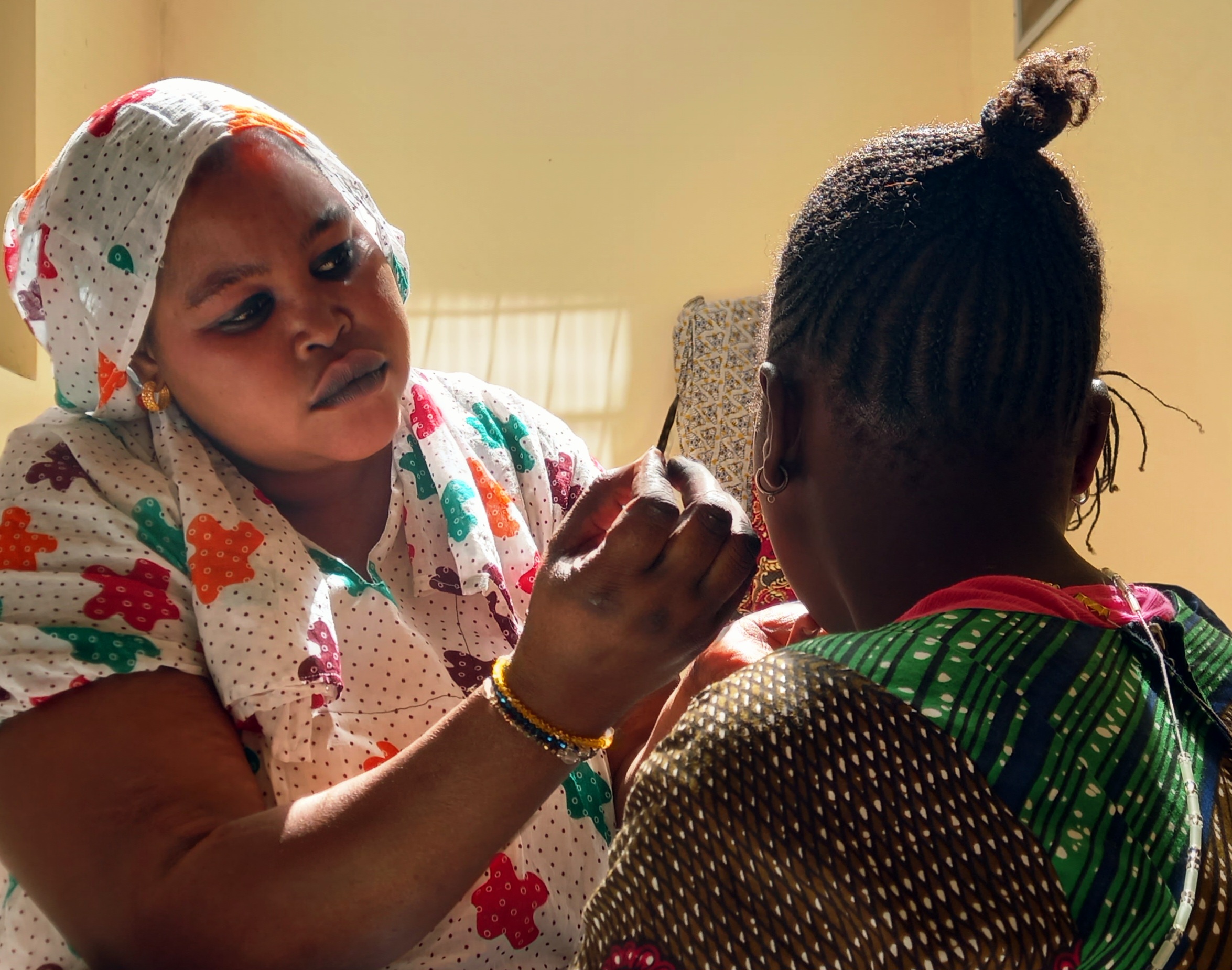
“In the beginning, after having given birth, you’re pampered and taken care of, and there will always be helping hands around”, Aminata explains. “But my sisters–in–law also have children, and sooner or later you need to help out. Go to the market, prepare food. And you of course take your baby with you. That’s the first time I really started thinking about the heat from another perspective than my own. Instead of only being annoyed by the heat, I was concerned about my baby.”
In Senegal, as in many other parts of the world, babies are carried on their mothers’ backs, strapped with a cotton cloth known as mbootu in Wolof, the most spoken language in Senegal. “It was difficult,” Aminata says. “On one hand, you want to protect your baby against sand and dust, but also against the sun. We all use small hats on our babies’ heads. I was constantly worried if my baby was drinking enough in the heat, or how the sun hit him as I was walking with him on my back. I was so stressed.”
Aminata’s story is deeply personal – and increasingly global.
Heat and the most vulnerable moments of life
Evidence is mounting. According to recent data by the World Meteorological Organization, 2025 was among the three warmest years on record, and extreme heat is now one of the deadliest climate-related hazards worldwide. Recent studies show that exposure to high temperatures during pregnancy is associated with increased risks of preterm birth, stillbirth, low birthweight, and hypertensive disorders. Newborns and infants, whose bodies cannot regulate temperature effectively, are at higher risk of dehydration and heat stress.
These risks are not confined to Aminata’s city, Louga, or to any one region. Heatwaves are intensifying across the globe. In cities, the urban heat island effect pushes temperatures even higher. And in humanitarian and fragile settings, access to cooling, water and health services is often limited – amplifying danger for pregnant women, newborns and young children.
Yet despite these known risks, maternal, newborn and child health (MNCH) remains insufficiently integrated into heat-health planning, early warning systems, and climate services for health efforts.
The information gap: connecting climate and health
One of the core challenges lies at the intersection of climate systems and health systems.
“Meteorological agencies routinely monitor and forecast heat hazards, while health systems serve people and Ministries of Health track outcomes such as maternal and newborn deaths, and health service coverage”, says Joy Shumake-Guillemot, Head of the WHO/WMO Climate and Health Joint Office in Geneva, Switzerland. “But these entities and data streams rarely “speak” to each other or speak the same language. This is what we are changing through the WHO/WMO Climate and Health Joint Programme.”
“We know that extreme heat is already harming health, but in many countries it is still not possible to have a clear picture of who is being affected, where risks are highest, and how impacts are changing over time. Strengthening heat-health monitoring within national public health institutes is essential to give decision-makers the evidence they need to act earlier and better protect the communities most at risk”, says Alejandro Saez Reale, Technical Support Unit Coordinator of the Global Heat Health Information Network.
Heat-related indicators are often inconsistent, and surveillance systems often fail to capture outcomes such as pregnancy complications or heat stress in infants. Without data, risks remain invisible and underprioritized.
“This is why we decided to host a workshop, as part of the EU-funded HIGH Horizons project – Heat Indicators for Global Health”, explains Anayda Portela, Scientist in the Sexual, Reproductive, Maternal and Newborn Health Unit at the World Health Organization. “We brought together various actors from across countries and regions, ranging from midwives to meteorologists, public health, surveillance, academia and MNCH country programmes, and together, they had a lot of ground to discuss, including how we all can work better together to address heat-related MNCH needs.”
Gathering expertise
For three days, over discussions and working groups, workshop participants gathered in Geneva, converging on several critical priorities, such as:
- Integrating MNCH into heat and climate health indicators, ensuring pregnancy, newborn and child outcomes are systematically tracked alongside heat exposure.
- Strengthening climate-informed health surveillance and programme monitoring, linking meteorological data with routine health information systems and early warning systems.
- Equipping health facilities and health workers with practical guidance and tools to prevent and manage heat risks, including in maternity care settings.
- Supporting countries to adapt heat–health action plans, surveillance and governance frameworks to explicitly include MNCH.
“What has long been missing is a shared scientific and operational language that enables climate data, health surveillance systems, and frontline experience to speak to one another in meaningful ways”, says Fortunate Machingura, Director of Climate, Environment and Health at the Centre for Sexual Health, HIV and AIDS Research (CeSHHAR) in Harare, Zimbabwe, who attended the workshop, and is a key partner in the HIGH Horizons project. “This workshop marked an important shift. It brought together actors who have often worked in parallel, but rarely in concert. As I leave, my hope is that this convergence can now be translated into concrete, country-level case studies—demonstrating how maternal, newborn and child health can be systematically embedded within heat surveillance, early warning systems, and climate-resilient health planning. If done well, these practical examples could provide a template that is adaptable and scalable across diverse African contexts.”
According to Anayda Portela, the workshop’s most important outcome was that it delivered exactly what MNCH programmes have been asking for: clarifying the priorities related to heat and MNCH and defining the next steps for country action. “It’s like three big wins: we got the an interdisciplinary group of experts together; they agreed on a set of priority indicators to monitor the impact of extreme heat on maternal, newborn and child health and how to integrate them into ongoing plans and frameworks while also identifying flexible solutions countries can adapt to their own systems. These scientific communities cannot work in silos – real impact will only come from embedding MNCH needs into the broader climate change and health and surveillance agendas.”
As temperatures continue to rise, the question is no longer whether heat will affect maternal and child health, but whether we will act in time. For Aminata, and millions of families like hers around the world, bridging climate services and health could mean the difference between crisis and coping.